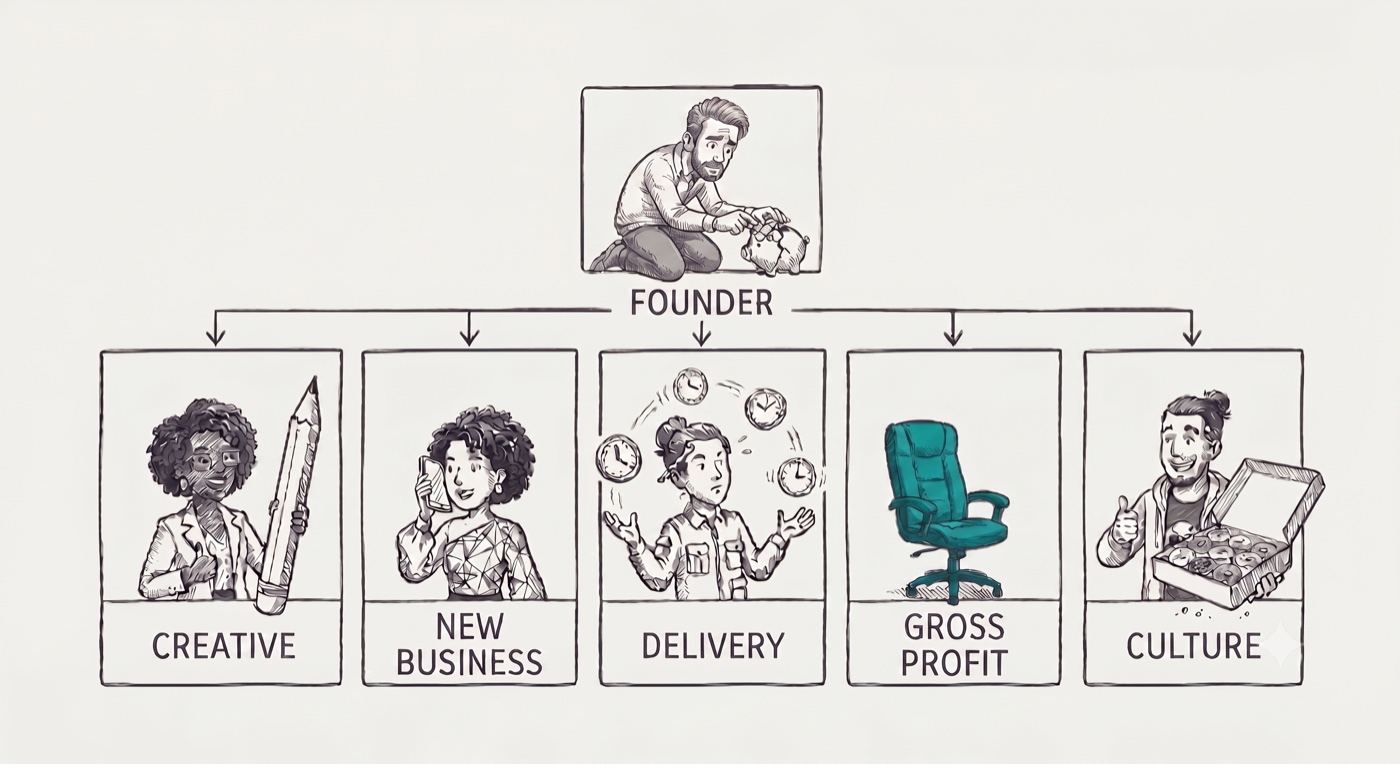
Dust off the team accountability chart. New business, creative, delivery, finance and, increasingly, culture all have names by them. Now find the name next to profitability. Not budgeting, costing, or financial reporting after the fact. Gross Profit.
In most independent creative companies, profit isn’t treated as a function. It’s a residue: whatever’s left at the end of the year or quarter once everyone has done their job. Everyone’s doing their job well, but nobody’s sole focus is on protecting the money.
The industry’s own numbers show the footprint. BenchPress, the largest benchmark survey of UK independent agencies, puts average gross profit for £1m+ agencies at 43%. Its benchmark for a healthy agency is 50%. Seven percent between average and healthy.
When margin slips, the instinct is for more vigilance. Watch the numbers harder. Tighten overheads. Chase timesheets. Add a live dashboard. But vigilance alone isn’t a replacement for function. It’s what you do instead of having one.
From my conversations with peers and founders, when I ask who owns gross profit margin for their agency or studio, nine times out of ten I get one of two answers. The quick one is “production.” But budgeting is not pricing. Knowing what a job costs to deliver is not deciding what it’s worth or taking control of the company’s commercial model. And controlling spend alone is not enough to protect gross profit. If those feel like the same thing inside your shop, that’s a flag that you are muddying functions and not capturing the full value of your offering.
Another answer: “Well… me?” The founder. Not by design, but by default. Unowned things default to the founder, who, as David C. Baker has observed, is likely the firm’s softest touch on price. They are too close to the relationship, too worried about covering payroll, and too invested in the win.
And a separate MD rarely changes the picture. They are carrying the weight of the entire operation, from client health to talent retention. While the P&L and macro numbers get their constant attention, the micro-leaks of daily project delivery can rarely get their focus. A function held by default isn’t owned; it’s borrowed.
I know this function can be owned, because I owned it. Across thirteen years in production, creative services, and agency operations, my job titles never said “commercial,” but every role was deliberately built around gross profit. The commercial spine of the business ran across my desk by design: scoping, pricing, negotiating, developing new commercial models, and protecting the margin after the “yes.”
The fix isn’t more vigilance. And it doesn’t necessarily require an expensive hire. It’s doing deliberately what the best-run companies already do: treating profitability targets as non-negotiable and working backwards from them. It means treating it as a function and giving it to somebody by design. A leader whose sole focus is the margin. Someone carrying a mandate, building the commercial architecture, and leading a culture where protecting the money is the standard.
The Prize
The prize is bigger than intuition suggests.
By example, for a £4m turnover company, every percent of gross profit is worth £40,000 a year. Even a realistic 2% improvement is £80,000 of additional gross profit every year without winning a single new client.
And if you’re aspiring to sell your company, consider this: that profit drops straight to the bottom line without adding any overhead, and goes directly into your EBITDA. On a modest 4x valuation multiple, that quiet 2% GP shift could add £320,000 to the enterprise value of the business.
Whatever it costs to put a name on the function, the gap costs more.
So take one more look at your accountability chart: whose name is next to the money?